GEO / AI SEO: The 10 Biggest Myths, Debunked
GEO and AI SEO myths can make it difficult for businesses to know what actually works in AI search. From AI citations and Google AI Overviews to ChatGPT and GEO strategies, many common assumptions about AI SEO are not supported by real-world evidence.
The Rundown
- AI SEO and GEO are not just a third-party PR game. Owned website pages can earn AI citations when they provide the right answer to the right prompts. I have seen well-structured pages gain AI visibility without relying on outside publicity because AI systems value useful information over promotion.
- Publishing more content does not guarantee AI visibility. AI systems reward specific answers to buyer questions instead of content volume. Creating focused pages that solve real problems usually performs better than producing many articles with little value.
- Answer placement matters more than many people think. Place summaries, definitions, and key facts near the top of the page so AI systems and readers can quickly understand the topic before moving into detailed explanations.
- Statistics, grounding pages, and accurate brand information help AI verify and cite your content. Supporting important claims with reliable data increases trust and gives AI systems stronger reasons to reference your pages.
- Updating only the date without updating content may create short-term LLM gains, but it is risky for Google visibility. Refreshing facts, examples, and insights is a much safer long-term strategy.
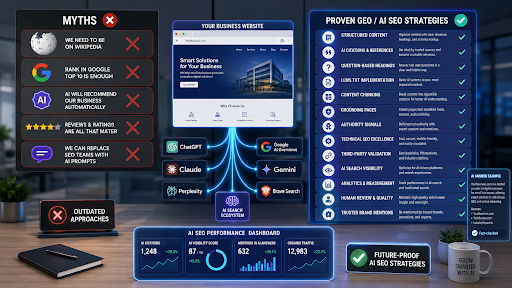
- Wikipedia is not required for AI visibility. It becomes more useful for reputation management when a brand already has independent coverage from trusted websites and respected industry sources.
- Ranking in Google’s top 10 is helpful, but AI systems can also discover useful pages through long-tail and fan-out queries. This means smaller websites still have opportunities to earn valuable citations.
- A citation is different from a recommendation. Brands should track named mentions along with source links because both provide useful insights into how AI systems recognize and reference a business.
- Review volume and star ratings alone do not determine AI rankings. Trusted review sources and positive sentiment often have a greater impact because they help establish credibility and confidence.
- LLM prompts can speed up SEO work by helping with drafting and research, but they cannot replace strategy, analytics, testing, or human review. Successful AI SEO still depends on careful planning, expert decisions, and continuous improvement.
AI SEO Myths Start Here
From my experience, AI SEO and GEO (Generative Engine Optimization) require proven methods instead of shortcuts or half-tested advice. While traditional SEO has evolved over the years, many people still believe every plausible idea automatically works. In reality, success often lasts briefly under narrow conditions before strategies fall apart. Careful testing by Coalition, RankScale, and their partners examines actual citation behavior across AI search results. Their research shows there is no single version for improving AI visibility because every PR problem, content volume problem, Wikipedia problem, and prompt engineering problem requires a different approach. Their evidence reveals what breaks down, what partly holds up, and how brands should take instead better practices through smarter AI SEO and GEO conversations.
Table of Contents
AI SEO Myth 1: Why GEO Is Not Just a Third-Party PR Game and Why Your Own Website Still Counts
Many small business owners believe AI SEO depends only on digital PR and third-party mentions. However, your own website is often the strongest source for AI citations when it answers customer questions clearly. Well-structured pages, product information, FAQs, and helpful guides give AI models the information they need. Building content around user intent allows your website to become a trusted source instead of depending only on external websites.
In my experience, combining owned content with digital PR creates the best results. Review sites and community discussions help build trust, but your website should always remain the main source of accurate information. Focus on answering real buyer questions, organizing content properly, and keeping important details easy to find. This approach helps improve AI visibility throughout every stage of the customer journey.
AI SEO Myth 2: Why Publishing More Content Does Not Mean the Citations Will Follow
A successful content strategy should provide value, demonstrate expertise, and establish authority for an e-commerce business. Informational content should support the buying journey rather than remain disconnected from product and category pages. Buyer guides, comparison articles, trend content, and educational content can help shoppers make informed decisions while attracting early-stage shoppers who may later become customers.
Examples such as Top LED Video Wall Trends in 2026 and How to Choose a Professional Audio Mixer can support a broader content strategy. Content clusters connect interconnected groups of related content, strengthening topical authority. High-quality content may also appear in AI-powered results, creating additional brand exposure and supporting long-term authority building.
Link authority and e-commerce trust signals are equally important. Strategic outreach and PR can help earn links from reputable publishers, while review schema, user-generated content, verified reviews, authentic user ratings, third-party mentions, and citations from respected sources can strengthen credibility. These activities help establish an authoritative site, improve brand authority, and support ranking stability. They can benefit SEO for small businesses as well as established e-commerce brands.
A complete e-commerce SEO package should combine the core elements required to improve visibility, rankings, conversions, and relevance. A cohesive approach should bring together technical SEO audit, keyword strategy, on-page optimization, content development, authority building, performance reporting, site structure, and high-intent organic traffic.
AI SEO Myth 3: Why AI Does Not Read Your Whole Page and Why Answer Placement Matters
Many people assume AI carefully reads every word on a page, but that is rarely how modern AI systems work. Important information placed near the beginning is easier for AI models to understand and reference. Clear summaries, definitions, headings, and key facts help both readers and AI quickly identify the purpose of the page without searching through unnecessary details.
From my experience, placing the main answer first creates better engagement and stronger AI citations. Organize content with descriptive H2 and H3 headings, followed by supporting details and examples. This simple structure improves readability, saves processing time for AI systems, and increases the chances that your content will be selected when answering related user questions.
AI SEO Myth 4: Why Strong, Polished Prose Does Not Beat Statistics
Excellent writing is valuable, but polished language alone is not enough for AI SEO. AI models prefer information supported by facts, statistics, research, and verifiable data because these signals increase confidence. Pages that include reliable numbers and evidence often become more useful references than pages filled only with attractive marketing language.
I regularly see stronger results when businesses combine clear writing with trustworthy data. Add original statistics, case studies, fact sheets, product details, and research whenever possible. This combination helps AI systems verify important claims while making the content more valuable for readers who want practical information before making a buying decision.
AI SEO Myth 5: Why Just Updating the Published Date Will Not Make AI Treat You as Fresh
Changing only the published date does not make old content valuable again. Some AI systems may briefly notice a newer date, but search engines and advanced AI models also evaluate whether the actual content has improved. Simply changing timestamps without meaningful updates is a weak long-term strategy that may reduce trust instead of increasing visibility.
The better approach is to refresh important pages with new research, updated examples, current statistics, improved explanations, and recent industry changes. I recommend reviewing key content regularly instead of relying on shortcuts. Consistent improvements help both AI systems and search engines recognize that your website continues providing accurate, useful, and trustworthy information.

AI SEO Myth 6: Why You Need a Wikipedia Page to Show Up in AI – Or Do You?
Many business owners believe AI SEO depends on having a Wikipedia page, but Myth 6 proves that idea is incorrect. An 80% analysis may suggest many successful brands have one, yet RankScale has been cited without it. From my experience, mature brands earn visibility through outside coverage, not because of a single entry. Strong third-party coverage, consistent brand recognition, and trusted information help AI understand authority more naturally. Instead of creating a page too early, focus on building real credibility that search engines and AI systems can recognize through reliable mentions and valuable content over time.
A Wikipedia page is most useful for reputation management after a brand has already gained independent press and wider recognition. An encyclopedic page can become a stabilizing source for brand-level prompts, but a commercial query rarely depends on it. A moderator may remove pages created without enough authority, while paid advertorials provide little value. I always recommend earning trust first through useful content, genuine media attention, and authentic industry recognition. Once the brand deserves an entry, AI systems are far more likely to understand and reference the business accurately across different search experiences.
AI SEO Myth 7: Why You Have to Rank in Google’s Top 10 to Get Cited – Not Always
Many people think reaching Google’s top 10 is the only way to earn AI visibility, but Myth 7 shows another path. A model often expands a prompt into sub-queries, creating a generated query with zero search volume. Searches like best running shoes features comparison may never be typed directly into Google, yet they still influence AI answers. Smaller brands can compete by creating focused pages instead of chasing only broad keywords. I have seen businesses gain citations simply by answering detailed customer questions with useful information that larger competitors ignored.
Pages sitting at position 20 or position 30 for the head term can still receive valuable citations. Claude frequently follows Brave Search, making that index important for developers targeting AI platforms. While Google’s top 10 continues supporting AI visibility through AI Overviews and AI Mode, it is no longer the only ranking signal that matters. A practical content strategy built around detailed search intent creates better opportunities for smaller brands to appear in AI-generated responses without depending entirely on traditional search rankings.
AI SEO Myth 8: Why AI Cites Your Page and Why It Does Not Always Recommend Your Brand
Many businesses assume an AI citation automatically means a recommendation, but Myth 8 explains the difference. Semrush reported that about 62% of AI citations are ghost citations, where the answer comes from your page but your brand is never named. Only 13% include both the source and the business name. I have seen this happen because AI focuses first on delivering information instead of promoting companies. Businesses should measure named mentions alongside citations to understand how often their brand receives real recognition.
Another common issue involves the self-promotional listicle. Since a Google core update, many 10 Best posts have highlighted competitors instead of the author. Coalition has received free links and mentions from agencies working in different specializations because those articles referenced useful information. This demonstrates why raw citation counts are not enough to measure AI SEO success. A stronger strategy focuses on building authority, earning trust, and increasing brand recognition instead of expecting every AI citation to become a recommendation.
AI SEO Myth 9: Why More Reviews and Higher Star Ratings Do Not Push You Up in AI Answers
Many owners believe more reviews and higher star ratings automatically improve AI answers, but Myth 9 tells a different story. Testing using G2 and Capterra found little connection between review volume, star rating, and AI ranking. Instead, every model evaluates trusted sources when a consideration-stage prompt appears. Local businesses should still encourage reviews because Google, Maps, and local results continue using them as important ranking signals. Positive customer feedback remains valuable even when it does not directly increase AI citations.
Sentiment has a lasting effect because training data remains unchanged until the next model cutoff. A negative Trustpilot review may continue shaping the baseline opinion of a product long after the original issue has been fixed. I always suggest responding quickly to illegitimate reviews instead of waiting for newer positive feedback to replace them. AI search systems remember older information much longer than many businesses expect, making reputation management an important part of long-term AI SEO success.
AI SEO Myth 10: Why Prompting an LLM Well Enough Cannot Replace Your SEO Team
Many marketers believe the right prompt allows an LLM to replace an experienced SEO team, but Myth 10 proves otherwise. Training-data experiments show that web search, models, and citations still contain limitations. Some linked pages never include the expected content, creating the well-known hallucination problem. Even when an answer sounds correct, an AI-generated SEO plan may rely on an outdated training corpus instead of your real business information. AI is powerful, but expert judgment still matters throughout every optimization project.
From my experience, Coalition demonstrates that small businesses perform better when chatbot strategy supports analytics, ad accounts, and experienced decision-making. Leading AI labs continue hiring SEO leads because human expertise remains essential. AI can speed up production, handle bulk jobs, create summary paragraphs across hundreds of pages, and improve efficiency. However, careful human review is still necessary before publishing important content. The best results come from combining AI tools with experienced professionals instead of replacing them completely.
Why the GEO Strategy Should Match the Evidence for Better AI SEO
A successful GEO strategy should always be based on evidence instead of assumptions or shortcuts. From my experience, AI SEO delivers better results when brands make their information easy to retrieve, verify, interpret, and cite. Focus on answering the specific questions buyers ask rather than creating content only for search engines. A well-structured website, high content quality, reliable third-party validation, and strong authority signals help improve AI citation behavior. Experienced people, a clear search strategy, and a solid understanding of AI systems make it easier to build lasting visibility through accurate and trustworthy information.
I have found that continuous learning and testing produce stronger results than following popular trends. Resources such as RankScale webinars on YouTube explain topics like LLMs.txt, content chunking, listicles, question-based headings, grounding pages, on-page assumptions, and off-page AI SEO myths. They also cover Wikipedia, Reddit, social media, reviews, and third-party mentions. A practical AI visibility strategy should include regular audits, stronger technical structure, accurate brand mentions, and ongoing improvements that help AI search and traditional search understand and trust your business over time. If you want to improve your website’s AI visibility and search performance, explore our SEO services or contact us to discuss a strategy tailored to your business.